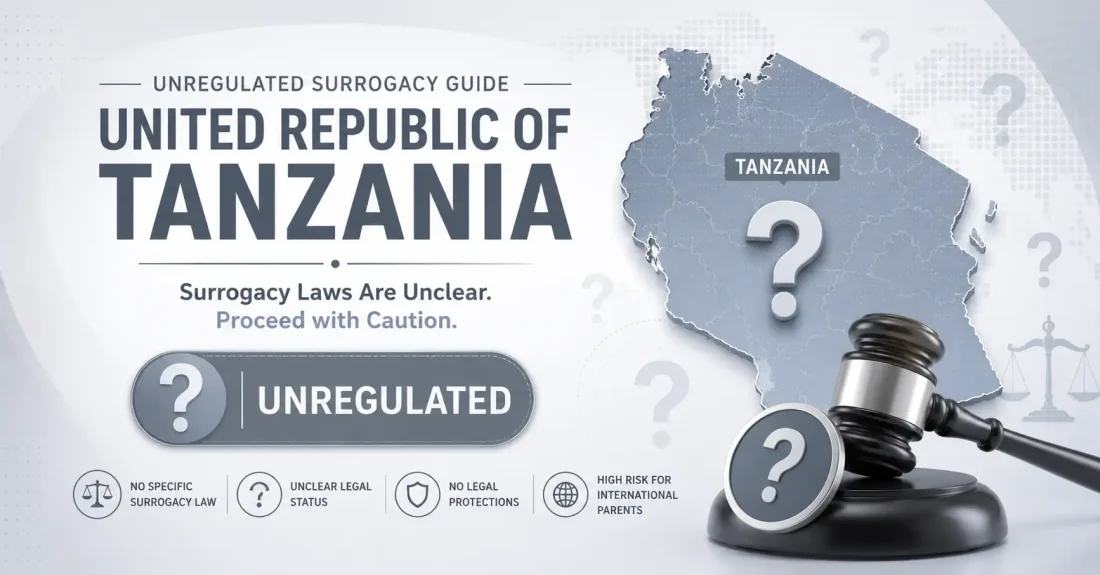
Surrogacy Law in the United Republic of Tanzania
❓ UNREGULATEDSurrogacy is neither explicitly legal nor illegal in Tanzania — the legal status is unclear
📋 Overview Unregulated
The United Republic of Tanzania currently has no specific legislation addressing surrogacy. The practice exists in a legal grey area — it is neither explicitly permitted nor prohibited under Tanzanian law.
Tanzania does not have any established legal framework for assisted reproduction or surrogacy arrangements. This lack of regulation creates significant uncertainty for anyone considering surrogacy in the country. Without clear laws, surrogacy agreements are not enforceable, and parentage rights are not guaranteed.
Surrogacy in Tanzania operates in a legal vacuum. There are no laws protecting surrogates, intended parents, or children born through surrogacy. Any arrangement carries significant legal risks.
⚖️ Legal Status
Tanzania's legal system is based on a combination of English common law, Islamic law, and customary law. Surrogacy is not addressed in any of these frameworks.
- No Surrogacy Legislation: Tanzania has no specific laws regulating surrogacy or assisted reproduction.
- No Regulatory Body: There is no government authority overseeing surrogacy arrangements.
- Parentage Laws: Under existing family law, the woman who gives birth is presumed to be the legal mother.
- Contracts Not Enforceable: Surrogacy agreements have no legal standing in Tanzanian courts.
Without a legal framework, there is no mechanism to establish parentage for intended parents. The surrogate would be recognized as the legal mother, and adoption may be the only pathway — which itself is complex and uncertain.
🚨 Risks & Challenges
The absence of a legal framework creates significant risks for all parties involved:
- No Parentage Recognition: Intended parents cannot obtain pre-birth or post-birth parentage orders.
- Surrogate Rights: The surrogate has no legal protections — and no guaranteed rights.
- Child's Status: The child's legal status and citizenship may be uncertain.
- No Medical Guidelines: There are no medical regulations for surrogacy procedures.
- International Recognition: Children born through surrogacy in Tanzania may not be recognized in other countries.
- Exploitation Risk: Lack of regulation increases the risk of exploitation of surrogates.
Due to the complete lack of legal protection and recognition, Tanzania is not recommended as a destination for surrogacy. Intended parents are strongly advised to seek countries with clear, enforceable legal frameworks.
🌍 For International Families
Tanzania is not a viable destination for international surrogacy. Here's why:
- No Legal Framework: There are no laws to protect your parentage rights.
- No Pre-Birth Orders: You cannot establish legal parentage before the child's birth.
- No Citizenship Guarantee: Your child may not be eligible for Tanzanian citizenship or a passport.
- Embassy Recognition: Most embassies will not recognize surrogacy arrangements in countries without legal frameworks.
- Travel Risks: You may face challenges traveling with your child if parentage is not legally established.
For international intended parents, we strongly recommend considering countries with established surrogacy laws, such as the United States, Ukraine, Georgia, or Greece, where legal parentage is clearly defined and protected.
📊 Quick Facts
- Status: Unregulated
- Commercial Surrogacy: ❓ Unclear / Not Regulated
- Altruistic Surrogacy: ❓ Unclear / Not Regulated
- Pre-Birth Order: ❌ Not Available
- Foreigners Allowed: ❓ Unclear
- Legal Framework: ❌ None
- Medical Facilities: ❌ Limited / None
💡 Considering Surrogacy?
Since surrogacy is unregulated in Tanzania with no legal framework to protect your rights, we recommend exploring countries with established, secure, and legally recognized surrogacy frameworks.
- 🇺🇸 United States — Strongest legal protections
- 🇺🇦 Ukraine — Top European destination
- 🇬🇪 Georgia — Favorable surrogacy laws
- 🇬🇷 Greece — EU destination with clear regulations
- 🇨🇦 Canada — Altruistic surrogacy available
- 🇮🇷 Iran — Fully legal for married heterosexual couples
These countries offer:
- ✅ Clear legal frameworks
- ✅ Pre-birth parentage orders
- ✅ Medical infrastructure
- ✅ Experienced professionals
- ✅ International recognition
- ✅ Surrogate protections